Transferring Energy Through Impact in Films
I love watching films and I love to see that the filmmakers put thought into the physics of a world, especially when superhuman forces are at work. I’ll even allow laws to slide when the film is supposedly set in the future, and advanced technology can be used as an excuse for why something should be possible. In this paper, we will be looking at altered movie physics related to Momentum/force impact, or what kind of force is required to stop a moving object. When an object is stopped suddenly, the momentum energy is released in the force of its impact. Ordinarily the force of the impact would be lessened by reducing momentum, but that is also rarely used in movies unless it adds to the dramatic effect. Movies often bend or completely break this law to make actions seem more dramatic, or to show a character’s power. This is true in live-action movies as well as animated cartoons.
I absolutely love Batman and the mythos surrounding him, and most of what he’s able to do is explained away by his incredibly advanced tech and weaponry. At the same time, Batman is a huge deal as a hero because he is supposed to be a mortal man, who will take very real damage if he is hit. In the movie he even has his back broken by a villain, further illustrating his ‘only human’ characteristic. This first scene is from The Dark Knight Rises, and is a scene where characters on screen stop suddenly after nearly reaching terminal velocity. If you catch someone falling at terminal velocity and you do nothing to slow-out their fall, they will still experience massive damage. In The Dark Knight Rises, prisoners in the deep pit tie a rope around their abdomens for safety as they climb the walls. When Christian Bale ties the rope around his abdomen and falls, there is no way he didn’t hurt his back or break a few ribs when it jerks taut. He also just had a recent devastating back injury, so he would be even more vulnerable to injury. Rescue operations personnel are equipped with full body harnesses to distribute the impact of a sudden drop on their body, ensuring the least amount of bodily harm occurs as possible. Rock climbers also wear a harness that allows the impact of suddenly stopping to be distributed into their hips and legs, the hip joint bending easily to absorb impact. So while Christain Bale’s Bruce Wayne did use a thick rope to prevent being cut in half from the impact, he still would have severely hurt himself. Additionally, the top of the rope was secured to the side of the wall, and in the event of someone falling, they would have swung right into the wall at full speed, most likely killing them.

In animated movies, the laws of physics are often broken more than in live action movies. For example, the amount of force applied that can throw someone across the room and into a wall will kill them. In The Incredibles, Mr. Incredible punches his boss Mr. Humphry across a room and through several walls. Not only did he go through all of the walls, but he went through all of them at the same height, meaning he went fast enough to go through all of them before gravity started to take effect. This should have killed him, but he is instead put into a full body cast to show the damage. While the force required to knock his whole body through a wall is significant, the initial force required to throw him through the air and through several walls would have killed him. The sudden impact on his body from someone with super strength would have broken bones and probably caused internal trauma. In the world of the movie, however, it does help to set up the rules of the universe. Normal humans in the movie easily experience heavy damage when up against heroes, therefore elevating the power of a hero in the audience’s eyes. Admittedly, this is also a cartoon, and cartoon characters are often portrayed as far more durable than real-life people, so most audiences approach cartoons without keeping real world physics in mind.

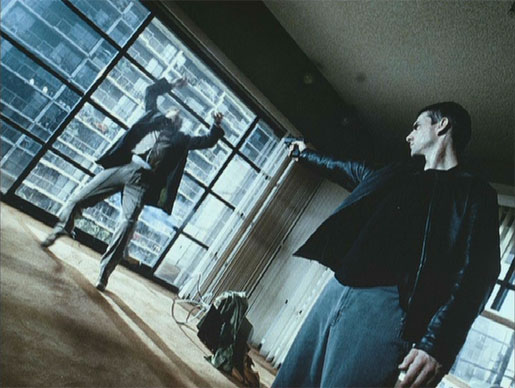
In many movies, it is popular to show a character being blown backwards out of frame from a gunshot. This is completely un-true, as these people are often said to be killed by the bullet. A bullet does not have a wide-area of energy dispersal, so someone who is shot without wearing a bullet-proof vest will not be thrown back by the force. They would, however, drop to the ground after being shot and suffer massive internal injuries. In Minority Report, a man is shot with enough force to throw him through a window behind him. He is not wearing a bullet-proof vest for the bullet to spend its momentum force into, which means that it slowed to a stop inside of him or exited out of his body. But most importantly, this is especially impossible since the force used to throw his body backwards would have had an equal and opposite force on the gunman who fire the bullet. As it is shown in the scene, the gunman doesn’t even move from the recoil and barely even jerks backwards as he fires the gun.
Movies most often bend the laws of physics for dramatic purposes, and the laws of Momentum and force impact are no different. However incorrect and misleading it is to viewers, it gives the film more drama and action scenes feel even more amazing when the laws are broken. I think movies easily wouldn’t be as fun if their makers kept strictly to completely accurate laws of physics. We would never get to feel that extra kick of emotion that is ‘movie magic’, and we wouldn’t get to expand our own imaginations with the stories told on screen without breaking these laws. For the sake of films, emotional imagery trumps logic every time, and laws sometimes need to be bent to allow for super-humans or exceptional technology.
